
Spiritual Micro-Dosing: Part 2
Little Hits, Big Changes


You Don’t Have to Play Tag with God
Do you remember what a good game of tag felt like? Or, for the violent among us, king of the hill? Both activities revolve around a winner-take-all mechanic to keep the game alive. The idea is that you are either completely losing or completely winning. There’s no in-between. All of your drive comes from the desire to avoid being “it” or better yet, to enjoy the glory of being king.
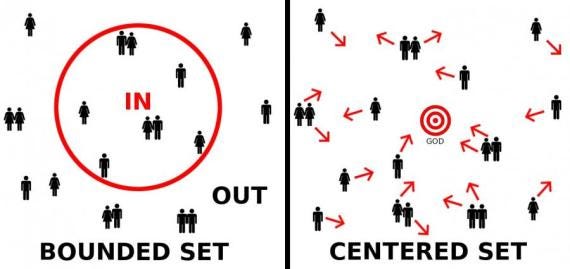
The purpose of both games is about crossing barriers. To make your way in and to avoid getting out. Missiologists like Alan Hirsch describe this way of thinking in the church-world as a bounded set.1 It’s the type of thought process that tells us that conversion happens in a moment, “just say this prayer with me and you’ll be saved”. Promising you can become an insider and never have to feel like an outsider again.
This same concept has a tendency to wiggle its way into our thinking about our spiritual practices too. Believing that we have to perform some set of actions for some period of time before we are “in” God’s Presence. We reinforce this belief with little messages to ourselves like:
“I only spent 5 minutes reading my Bible.”
“I didn’t really feel that worship song.”
“That sermon didn’t really resonate with me.”
“I didn’t have enough time to get in the zone with God.”
All of these scripts build up the concept of our being “in or out” of God’s Presence. To be sure—as we discussed in last week’s post—there is a place for extended times of seeking God and pursuing an encounter that affects your thoughts and emotions, but these moments are not the only ones that “count”.
The other framework to see our spiritual practices through is on the grid of a centered set. A centered set is not focused on boundaries that tell us if we are “in or out” but looks at the direction that our beliefs and actions are taking us — are they leading us closer or further from a Central Point (i.e. God)?
A centered set says that you could be an inch away from the bullseye, pointed in the wrong direction, and be worse off than the person who is a mile away, yet is moving in the right direction.
Viewing the world through a centered set seems to be the reason why Jesus could tell religious professionals that they were far from the heart of God even while they were serving in God’s House and, at the same time, He could tell the social outcast that they were on the right trajectory and close to The Kingdom (Luke 18:9-14).
2 Degree Change = 2 Miles Off Course
Author Michael Easter has fueled an entire writing career around the 2% club. The percentage refers to the amount of people who will take the stairs instead of an escalator when both are present.2 Even though 100% of people know that taking the stairs would be better for our long term health, 98% of us still choose the electric people mover.
The problem is that most of us see our health through a bounded set—“I am either working out or I am not”—instead of seeing our lives through a centered set that views EVERY action as one that moves us closer or further to optimal health.
Let me be the first to say that I am the chief of bounded set sinners. I have been a gym rat for almost 20 years and I can’t tell you how many times I’ve decided NOT to exercise because, “it wouldn’t be a full workout” and “if I can’t get my entire program in, then it won’t matter at all”.
I’ve also applied this mindset to my prayer life and the result was that I had to spend increasingly longer amounts of time on my prayer rug before I felt like I was really moving the needle. I started to think that I wasn’t being spiritual enough if I wasn’t constantly setting PR’s on the prayer mat.
The idea of spiritual mastery is not so much about how long we can sustain specific, “holy” activities, it is about how quickly we can adjust our aim back to the bullseye of God’s Heart. Ignatius of Loyola, the founder of the Spiritual Exercises, affirmed this view in a famous interaction:
“A colleague once asked Loyola how long he would need to recover if the pope was ever to disband the Jesuits. Loyola's response surely shocked his questioner, and it quickly found its way into Jesuit lore: "If I recollected myself in prayer for a quarter of an hour, I would be happy, and even happier than before.”3
Again, this is spiritual mastery that we are talking about. Of course it’s not normal for most of us to say that we could bounce back from the destruction of our life’s work in about 20 minutes. Spiritual mastery is about becoming the type of person who has dissolved the boundaries between the sacred and the secular and has come to view all of life as one uninterrupted experience of Abiding in The One Called Love. This is the kind of person we long to become and the type of person we are growing into through the practice of spiritual micro-dosing.
A Small Dose to Get You Started
Here’s a few small doses of spiritual practice that can start to move your thinking away from a bounded set and towards a centered set mentality. Little adjustments that are the equivalent of taking the stairs instead of the escalator next time you’re faced with both.
Reframing Your Forgetfulness
Every time you realize that you have forgotten you are living in God’s Presence, rejoice! Instead of telling yourself, “I have been failing up until this moment” say, “Thank You God for this moment of remembering that I am in Your Presence”.
Your focus will begin to shift from discouragement about all the moments you have forgotten God, to thankfulness for every moment you have remembered God.
Whether it’s been 2 minutes or 2 months since the last time you were aware of God, this micro-dose will begin to tell your soul that coming back is a reason for gratitude and not shame.
One Word, One Breath
Pick a 2 syllable word that represents your desire for God. Something like Je-sus or Spi-rit or Yah-weh. For me, I have been using the word A-bide for the past few years. It’s important to pick a word that is significant to your desire for God and has 2 syllables because it is going to be synced to your breath.
Take a moment for 3 deep breaths. As you inhale, breathe in the first syllable of your word “Yah—”. As you exhale, breathe out the second “Weh—”. After a few repetitions of this micro-dose you should feel the physiological benefits and have begun the work of connecting the reality of the air in your lungs with the Reality of God’s Presence.
Over time, a single breath in the middle of a busy day can be all that you need to come back into the awareness of abiding.
A Loving Look
Pick an image of Jesus. Whether through a painting or a piece of your imagination, find a visual image of Jesus that you want to be with. A depiction of Him that you wish was real and that you could just walk into that scene right now.
The image being “real” or “accurate” is not what’s important, the desire behind it is. In the words of Thomas Merton, “But in all these things, it is the will to pray that is the essence of prayer, and the desire to find God, to see Him and to love Him is the one thing that matters.”4
For an extra hit of this spiritual micro-dose, imagine that your image is physically above you. Tilt your head up slightly and send a loving look in this direction. And see what Loving Look might come back at you.
https://www.missionalchurchnetwork.com/blog/bounded-set-vs-centered-set-1

Lowney, Chris. Heroic Leadership: Best Practices from a 450-Year-Old Company That Changed the World. United States, Loyola Press, 2009. Pg 118
Merton, Thomas. New Seeds of Contemplation. United States, New Directions, 2007. Pg 224